John Barry Walkabout Rapidshare Movies
John Barry at the Royal Albert Hall, London, September 2006 | |
| Background information | |
| Birth name | John Barry Prendergast |
| Born | 3 November 1933 York, Yorkshire, England |
| Died | 30 January 2011 (aged 77) Oyster Bay, New York, U.S. |
| Genres | Film score |
| Occupation(s) | Composer, conductor |
| Instruments | |
| Years active | 1959–2006 |
John Barry Walkabout Rapidshare Free. 5/28/2017 0 Comments. John Barry, 'THE KNACK' - Movie Soundtrack. Watch the video or listen to John Barry – The Knack for free. The Knack appears on the album The Best Of John Barry. JAMES HORNER, JOHN BARRY, vangelis, FRANCIS LAI, BASIL POLEDOURIS, BILL CONTI. DVDRip free Download Torrent.
John Barry Prendergast, OBE (3 November 1933 – 30 January 2011)[1][2] was an English composer and conductor of film music. He composed the scores for 11 of the James Bond films between 1963 and 1987, and also arranged and performed the 'James Bond Theme' to the first film in the series, 1962's Dr. No. He wrote the Grammy- and Academy Award-winning scores to the films Dances with Wolves and Out of Africa, as well as the theme for the British television cult series The Persuaders!, in a career spanning over 50 years. In 1999, he was appointed OBE for services to music.
Born in York, Barry spent his early years working in cinemas owned by his father. During his national service with the British Army in Cyprus, Barry began performing as a musician after learning to play the trumpet. Upon completing his national service, he formed his own band in 1957, The John Barry Seven. He later developed an interest in composing and arranging music, making his début for television in 1958. He came to the notice of the makers of the first James Bond film Dr. No, who were dissatisfied with a theme for James Bond given to them by Monty Norman. This started a successful association between Barry and Eon Productions that lasted for 25 years.
He received many awards for his work, including five Academy Awards; two for Born Free, and one each for The Lion in Winter (for which he also won the first BAFTA Award for Best Film Music), Dances with Wolves and Out of Africa (both of which also won him Grammy Awards). He also received ten Golden Globe Award nominations, winning once for Best Original Score for Out of Africa in 1986. Barry completed his last film score, Enigma, in 2001 and recorded the successful album Eternal Echoes the same year. He then concentrated chiefly on live performances and co-wrote the music to the musical Brighton Rock in 2004 alongside Don Black. In 2001, Barry became a Fellow of the British Academy of Songwriters, Composers and Authors, and, in 2005, he was made a Fellow of the British Academy of Film and Television Arts. Barry was married four times and had four children. He moved to the United States in 1975 and lived there until his death in 2011.
- 1Biography
- 2Awards and nominations
- 3Filmography
Biography[edit]
Early life and education[edit]
Barry was born John Barry Prendergast, in York, England, and was the son of an English mother and an Irish father. His mother was a classical pianist. His father, John Xavier 'Jack' Prendergast, from Cork, was a projectionist during the silent film era, who later owned a chain of cinemas across northern England.[3][4][5] As a result of his father's work, Barry was raised in and around cinemas in northern England[3] and he later stated that this childhood background influenced his musical tastes and interests.[4] Barry was educated at St Peter's School, York, and also received composition lessons from Francis Jackson, Organist of York Minster.[4]
Career[edit]
Serving in the British Army, Barry spent his national service playing the trumpet.[6] During his army service, he took a correspondence course (with jazz composer Bill Russo); he also worked as an arranger for the Jack Parnell and Ted Heath's Orchestra,[7] and formed his own band in 1957, the John Barry Seven,[8] with whom he had some hit records on EMI's Columbia label. These included 'Hit and Miss', the theme tune he composed for the BBC's Juke Box Jury programme, a cover of the Johnny Smith song 'Walk Don't Run', and a cover of the theme for the United Artists western The Magnificent Seven.
By 1959 Barry was gaining commissions to arrange music for other acts, starting with a young trio on Decca, coincidentally called the Three Barry Sisters, though unrelated both to Barry and the more famous Barry Sisters duo in America.[9] The career breakthrough for Barry was the BBC television series Drumbeat, when he appeared with the John Barry Seven. He was employed by EMI from 1959 until 1962 arranging orchestral accompaniment for the company's singers, including Adam Faith;[10] he also composed songs (along with Les Vandyke) and scores for films in which Faith was featured. When Faith made his first film, Beat Girl (1960), Barry composed, arranged and conducted the score, his first. His music was later released as the UK's first soundtrack album.[11]
Barry also composed the music for another Faith film, Never Let Go (also 1960), orchestrated the score for Mix Me a Person (1962), and composed, arranged and conducted the score for The Amorous Prawn (also 1962). In 1962, Barry transferred to Ember Records, where he produced albums as well as arranging them.[12]
These achievements caught the attention of the producers of a new film called Dr. No (1962) who were dissatisfied with a theme for James Bond given to them by Monty Norman. Barry was hired and the result was one of the most famous signature tunes in film history, the 'James Bond Theme'. (Credit goes to Monty Norman, see here.) When the producers of the Bond series engaged Lionel Bart to score the next James Bond film From Russia with Love (1963), they discovered that Bart could neither read nor write music. Though Bart wrote a title song for the film, the producers remembered Barry's arrangement of the James Bond Theme and his composing and arranging for several films with Adam Faith. Lionel Bart also recommended Barry to producer Stanley Baker for his 1964 film Zulu.[13] That same year Bart and Barry collaborated on the film Man in the Middle; and then, in 1965, Barry worked with director Bryan Forbes in scoring the World War II prison-camp drama King Rat.
This was the turning point for Barry, and he subsequently won five Academy Awards and four Grammy Awards, with scores for, among others, Born Free (1966), The Lion in Winter (1968), Midnight Cowboy (1969) for which he did not receive an on-screen credit.[14] and Somewhere in Time (1980).[2]
Barry was often cited as having had a distinct style which concentrated on lush strings and extensive use of brass. However he was also an innovator, being one of the first to employ synthesizers in a film score (On Her Majesty's Secret Service, also 1969),[15] and to make wide use of pop artists and songs in Midnight Cowboy.[16] Because Barry provided not just the main title theme but the complete soundtrack score, his music often enhanced the critical reception of a film, notably in Midnight Cowboy, the first remake of King Kong (1976), Out of Africa (1985), and Dances with Wolves (1990). Barry would often watch films and would note down with pen and paper what worked or what did not.[5]
Barry composed the theme for the TV series The Persuaders! (1971), also known as The Unlucky Heroes, in which Tony Curtis and Roger Moore were paired as rich playboys solving crimes.[17] The instrumental recording features the Cimbalom (which Barry also used for The Ipcress File (1965) and other themes) and Moog synthesizers. The theme was a hit single in many European countries (including France, Germany, and the Benelux states), contributing to the cult status of the series in Europe, and the record featured Barry's The Girl with the Sun in Her Hair on the B side, an instrumental piece featured in a long running TV advert for Sunsilk shampoo. Barry also wrote the scores to a number of musicals, including the 1965 Passion Flower Hotel (lyrics by Trevor Peacock), the successful 1974 West End show Billy (lyrics by Don Black),[18] and two major Broadway flops, Lolita, My Love (1971), with Alan Jay Lerner as lyricist, and The Little Prince and the Aviator (1981), again with lyricist Don Black.
In 2001, the University of York conferred an honorary degree on Barry, and in 2002 he was named an Honorary Freeman of the City of York.[19][20]
During 2006, Barry was the executive producer on an album entitled Here's to the Heroes by the Australian ensemble The Ten Tenors. The album features a number of songs Barry wrote in collaboration with his lyricist friend, Don Black. Barry and Black also composed one of the songs on Shirley Bassey's 2009 album, The Performance. The song, entitled 'Our Time Is Now', is the first written by the duo for Bassey since 'Diamonds Are Forever'.[21]
James Bond series[edit]
After the success of Dr. No, Barry was hired to compose and perform eleven of the next fourteen James Bond films (Monty Norman is legally recognised as the composer of the 'James Bond Theme').[22]
In his tenure with the film series, Barry's music, variously brassy and moody, achieved very wide appeal. For From Russia with Love he composed '007', an alternative James Bond signature theme, which is featured in four other Bond films (Thunderball, You Only Live Twice, Diamonds Are Forever and Moonraker). The theme 'Stalking', for the teaser sequence of From Russia with Love, was covered by colleague Marvin Hamlisch for The Spy Who Loved Me (1977). (The music and lyrics for From Russia with Love's title song were written by Lionel Bart, whose musical theatre credits included Oliver!) Barry also contributed indirectly to the soundtrack of the spoof version of Casino Royale (1967): his Born Free theme appears briefly in the opening sequence.
In Goldfinger (1964), he perfected the 'Bond sound', a heady mixture of brass, jazz elements and sensuous melodies. There is even an element of Barry's jazz roots in the big-band track 'Into Miami', which follows the title credits and accompanies the film's iconic image of the camera lens zooming toward the Fontainebleau Hotel in Miami Beach. Jimmy Page was working as a session guitarist at the time, and was a part of the recording sessions for the 'Goldfinger' soundtrack.[23] For Bond films, session musicians such as Page were relegated to the instrumental/score versions of songs, while the main musicians (on Goldfinger such as Vic Flick) were given the main film theme song to record.[24] Thus, Flick is heard as lead guitarist on the main theme, leaving Page as a background acoustic contributor to Flick on the instrumental version of the song.
Just, after sharing them on quickly.Adobe Photoshop cs6 License Key with Keygen:However, Adobe Photoshop cs6 Activator lets you to manage color and painting also drawings. Adobe PhotoShop Cs6 Portable Free Download Activator Benefits:You can make your holidays memorable pictures memorable and more attractive and likely by people with Adobe Photoshop Cs6 Portable Download. Adobe photoshop cs6 license key kickass.
Barry's love for the Russian romantic composers is often reflected in his music; in his Bond scores he unites this with brass-heavy jazz writing. His use of strings, lyricism, half-diminished chords, and complex key shifting provides melancholy contrast - in his scores this is often heard in variations of the title songs that are used to underscore plot development.[25]
As Barry matured, the Bond scores became more lushly melodic (along with other scores of his such as Out of Africa), as in Moonraker (1979) and Octopussy (1983). Barry's score for A View to a Kill was traditional, but his collaboration with Duran Duran for the title song was contemporary and reached number one in the United States and number two in the UK Singles Chart. Both A View to a Kill and The Living Daylights theme by a-ha blended the pop music style of the bands with Barry's orchestration. In 2006, a-ha's Pal Waaktaar complimented Barry's contributions: 'I loved the stuff he added to the track, I mean it gave it this really cool string arrangement. That's when for me it started to sound like a Bond thing.'[26]
Barry's last score for the Bond series was The Living Daylights (1987), Timothy Dalton's first film in the series with Barry making a cameo appearance as a conductor in the film.[27] Barry was intended to score Licence to Kill (1989) but was recovering from throat surgery at the time and it was considered unsafe to fly him to London to complete the score. The score was completed by Michael Kamen.[28]
David Arnold, a British composer, saw the result of two years' work in 1997 with the release of Shaken and Stirred: The David Arnold James Bond Project, an album of new versions of the themes from various James Bond films. Arnold thanks Barry in the sleeve notes, referring to him as 'the Guvnor'. Almost all of the tracks were John Barry compositions, and the revision of his work met with his approval – he contacted Barbara Broccoli, producer of the then upcoming Tomorrow Never Dies, to recommend Arnold as the film's composer.[29] Arnold also went on to score four subsequent Bond films: The World Is Not Enough, Die Another Day, Casino Royale and Quantum of Solace.
Sole compositional credit for the 'James Bond Theme' is assigned to Monty Norman, who was contracted as composer for Dr. No. Some 30 years later, in 2001, the disputed authorship of the theme was examined legally in the High Court in London after Norman sued The Sunday Times for publishing an article in 1997 in which Barry was named as the true composer; Barry testified for the defence.[30][31]
In court, Barry testified that he had been handed a musical manuscript of a work by Norman (meant to become the theme) and that he was to arrange it musically, and that he composed additional music and arranged the 'James Bond Theme'. The court was also told that Norman received sole credit because of his prior contract with the producers. Barry said that a deal was struck whereby he would receive a flat fee of £250 and Norman would receive the songwriting credit.[32] Barry said that he had accepted the deal with United Artists Head of Music Noel Rogers because it would help his career. Despite these claims the jury ruled unanimously in favour of Norman.[32]
On 7 September 2006, John Barry publicly defended his authorship of the theme on the Steve Wright show on BBC Radio 2.[33]
Personal life and death[edit]
Barry was married four times. His first three marriages, to Barbara Pickard (1959–63), Jane Birkin (1965–68), and Jane Sidey (1969–78) all ended in divorce.[7] He was married to his fourth wife, Laurie, from January 1978[7] until his death. The couple had a son, Jonpatrick. Barry had three daughters, Suzanne (Susie) with his first wife, Barbara, Kate with his second wife, Jane, and Sian from a relationship with Ulla Larson between the first two marriages.[4] Suzy Barry, who is married to BBC business journalist Simon Jack, is the mother of his two granddaughters, Phoebe and Florence Ingleby.
In 1975 Barry moved to California. A British judge later accused him of emigrating to avoid paying £134,000 due the Inland Revenue.[7] The matter was resolved in the late 1980s and Barry was able to return to the UK.[7] He subsequently lived for many years in the United States, mainly in Oyster Bay, New York, in Centre Island on Long Island, from 1980.[4][34]
Barry suffered a rupture of the oesophagus in 1988, following a toxic reaction to a health tonic he had consumed. The incident rendered him unable to work for two years and left him vulnerable to pneumonia.[35]
Barry died of a heart attack on 30 January 2011 at his Oyster Bay home, aged 77.[36][37]
A memorial concert took place on 20 June 2011 at the Royal Albert Hall in London where the Royal Philharmonic Orchestra, Shirley Bassey, Rumer, David Arnold, Wynne Evans and others performed Barry's music.[38]Sir George Martin, Sir Michael Parkinson, Don Black, Timothy Dalton and others also contributed to the celebration of his life and work.[36][38][39] The event was sponsored by the Royal College of Music through a grant by the Broccoli Foundation.[40]
Awards and nominations[edit]
In 1999 Barry was made an Officer of the Order of the British Empire (OBE) for services to music. He received the BAFTA Academy Fellowship Award in 2005.[39][41] In 2005, the American Film Institute ranked Barry's score for Out of Africa No. 15 on their list of the greatest film scores.[42] His scores for the following films were also nominated:
- Goldfinger (1964)
- Born Free (1966)
- The Lion in Winter (1968)
- Somewhere in Time (1980)
- Body Heat (1981)
- Out of Africa (1986)
- Dances with Wolves (1990)
Accolades[edit]
| Award | Year | Project | Category | Outcome |
|---|---|---|---|---|
| Academy Awards | 1966 | Born Free | Best Original Score | Won |
| 'Born Free' (from Born Free) | Best Original Song | Won | ||
| 1968 | The Lion in Winter | Best Original Score for a Motion Picture (not a Musical) | Won | |
| 1971 | Mary, Queen of Scots | Best Original Dramatic Score | Nominated | |
| 1985 | Out of Africa | Best Original Score | Won | |
| 1990 | Dances with Wolves | Best Original Score | Won | |
| 1992 | Chaplin | Best Original Score | Nominated | |
| BAFTA Awards | 1968 | The Lion in Winter | Anthony Asquith Award for Film Music | Won |
| 1986 | Out of Africa | Best Score[43] | Nominated | |
| 1991 | Dances with Wolves | Best Original Film Score[44] | Nominated | |
| 2005 | BAFTA Academy Fellowship Award[45] | Won | ||
| Golden Globe Awards | 1966 | 'Born Free' (from Born Free) | Best Original Song | Nominated |
| 1968 | The Lion in Winter | Best Original Score | Nominated | |
| 1971 | Mary, Queen of Scots | Best Original Score | Nominated | |
| 1974 | 'Sail the Summer Winds' (from The Dove) | Best Original Song | Nominated | |
| 1977 | 'Down Deep Inside' (from The Deep) | Best Original Song | Nominated | |
| 1981 | Somewhere in Time | Best Original Score | Nominated | |
| 1985 | Out of Africa | Best Original Score | Won | |
| 'A View to a Kill' (from A View to a Kill) | Best Original Song | Nominated | ||
| 1990 | Dances with Wolves | Best Original Score | Nominated | |
| 1992 | Chaplin | Best Original Score | Nominated |
- 1969Best Instrumental Theme for Midnight Cowboy[46]
- 1985Best Jazz Instrumental Performance, Big Band for The Cotton Club[46]
- 1985Best Instrumental Composition for Out of Africa[46]
- 1991Best Instrumental Composition for Dances with Wolves[46]
Emmy Award nominations
- 1964 Outstanding Achievement in Composing Original Music for Television for Elizabeth Taylor in London (a 1963 television special)[47]
- 1977 Outstanding Achievement in Music Composition for a Special (Dramatic Underscore) for Eleanor and Franklin: The White House Years[47]
- 1981 Worst Musical Score for The Legend of the Lone Ranger
Max Steiner Lifetime Achievement Award (presented by the City of Vienna)
- 2009[22]
Lifetime Achievement Award from World Soundtrack Academy (presented at the Ghent Film Festival)
- 2010
Walkabout Movie Youtube
In 2011, he received the Brit Award for Outstanding Contribution to Music.
Barry was inducted into the Songwriters Hall of Fame in 1998.[22]
Filmography[edit]
Bond films[edit]
Barry worked on the soundtracks for the following James Bond films (title song collaborators in brackets):
- Dr. No (1962) – James Bond Theme (composed by Monty Norman) as arranged by Barry used on main and end titles, and key points such as Bond's arrival in Jamaica
- From Russia with Love (lyrics by Lionel Bart) (1963)
- Goldfinger (lyrics by Anthony Newley and Leslie Bricusse), (1964)
- Thunderball (lyrics by Don Black) (1965)
- You Only Live Twice (lyrics by Leslie Bricusse) (1967)
- On Her Majesty's Secret Service (1969)
- Diamonds Are Forever (lyrics by Don Black) (1971)
- The Man with the Golden Gun (lyrics by Don Black) (1974)
- Moonraker (lyrics by Hal David) (1979)
- Octopussy (lyrics by Tim Rice) (1983)
- A View to a Kill (music and lyrics by Duran Duran) (1985)
- The Living Daylights (music and lyrics by Paul Waaktaar-Savoy) (1987)
Other film scores[edit]
- Beat Girl (1960)
- Never Let Go (1960)
- The Cool Mikado (1962)
- The Amorous Prawn (1962)
- The L-Shaped Room (1962)
- Man in the Middle (1963)
- A Jolly Bad Fellow (1964)
- Séance on a Wet Afternoon (1964)
- Zulu (1964)
- Boy and Bicycle (1965)
- Mister Moses (1965) US
- Four in the Morning (1965)
- The Party's Over (1965)
- The Knack ..and How to Get It (1965)
- King Rat (1965) US
- The Ipcress File (1965)
- Born Free (1966)
- The Chase (1966) US
- The Wrong Box (1966)
- The Quiller Memorandum (1966)
- The Whisperers (1967)
- Dutchman (1967)
- Boom! (1968)
- Petulia (1968) US
- Deadfall (1968)
- The Lion in Winter (1968)
- The Appointment (1969) US
- Midnight Cowboy (1969) US
- Monte Walsh (1970) US
- The Last Valley (1970)
- They Might Be Giants (1971) US
- Murphy's War (1971)
- Walkabout (1971)
- Mary, Queen of Scots (1971)
- Alice's Adventures in Wonderland (1972)
- Follow Me! (1972)
- A Doll's House (1973)
- The Tamarind Seed (1974)
- The Dove (1974) US
- The Day of the Locust (1975) US
- King Kong (1976) US Italy
- Robin and Marian (1976) US
- The Deep (1977)
- First Love (1977) US
- The White Buffalo (1977) US
- Game of Death (1978)
- The Betsy (1978)
- Starcrash (1978) US
- Hanover Street (1979)
- The Black Hole (1979) US
- Somewhere in Time (1980) US
- Touched by Love (1980) US Canada
- Inside Moves (1980) US
- Night Games (1980) US
- Raise the Titanic (1980)
- The Legend of the Lone Ranger (1981) US
- Body Heat (1981) US
- Frances (1982) US
- Murder by Phone (1982)
- Hammett (1982) US
- The Golden Seal (1983)
- High Road to China (1983)
- The Cotton Club (1984) US
- Until September (1984) US
- Mike's Murder (1984) US
- Jagged Edge (1985) US
- Out of Africa (1985) US
- Howard the Duck (1986) US
- A Killing Affair (1986) US
- Peggy Sue Got Married (1986) US
- The Golden Child (1986) (only partially used in final cut) US
- Hearts of Fire (1987) US
- Masquerade (1988) US
- Dances with Wolves (1990) US
- Chaplin (1992)
- Year of the Comet (1992) (rejected score[citation needed])
- Ruby Cairo (1992) US
- My Life (1993) US
- Indecent Proposal (1993) US
- The Specialist (1994) US
- Cry, the Beloved Country (1995)
- Across the Sea of Time (1995) US
- The Scarlet Letter (1995) US
- Swept from the Sea (1997) US
- Mercury Rising (1998) US
- Playing by Heart (1998) US
- Goodbye Lover (1998) (rejected score[citation needed])
- Enigma (2001)
- The Incredibles (2004) (rejected score[citation needed])
Television film scores[edit]
- Elizabeth Taylor in London (Grammy award nomination) (1963)
- Sophia Loren in Rome (1964)
- The Glass Menagerie (1973)
- Love Among the Ruins (1975)
- Eleanor and Franklin (1976)
- Eleanor and Franklin: The White House Years (1977)
- The War Between the Tates (1977)
- Young Joe, the Forgotten Kennedy (1977)
- The Gathering (1977)
- The Corn is Green (1979)
- Willa (1979)
- Svengali (1983)
Television themes[edit]
- Juke Box Jury (1959–1967)
- Dateline (1962)
- Impromptu (1964)
- The Newcomers (1965–1969)
- Vendetta (1966)
- The Persuaders! (1971–1972)
- The Adventurer (1972–1973)
- Orson Welles' Great Mysteries (1973)
- Born Free (1974)
- USA Today: The Television Show (1988)
Musicals[edit]
- Passion Flower Hotel (1965)
- Lolita, My Love (1971), a musical comedy (text by Alan Jay Lerner) based on Vladimir Nabokov's novel Lolita
- Billy (1974)
- The Little Prince and the Aviator (1981)
- Brighton Rock (2004)
Other works[edit]
- Stringbeat (1961)
- Americans (1975)
- The Beyondness of Things (1999)
- Eternal Echoes (2001)
- The Seasons (no release date set)
Singles[edit]
(Excludes co-composed hits, e.g. Duran Duran's A View to a Kill)
- 'Hit and Miss' as The John Barry Seven plus Four, UK#10 (first charted 1960)
- 'Beat for Beatniks' as The John Barry Orchestra, UK#40 (1960)
- 'Never Let Go' as The John Barry Orchestra, UK#49 (1960)
- 'Blueberry Hill' as The John Barry Orchestra, UK#34 (1960)
- 'Walk Don't Run' as The John Barry Seven, UK#11 (1960)
- 'Black Stockings' as The John Barry Seven, UK#27 (1960)
- 'The Magnificent Seven' as The John Barry Seven, UK#45 (1961)
- 'Cutty Sark' as The John Barry Seven, UK#35 (1962)
- 'The James Bond Theme' as The John Barry Orchestra, UK#13 (1962)
- 'From Russia with Love' as The John Barry Orchestra, UK#39 (1963)
- 'Theme from 'The Persuaders' as John Barry, UK#13 (1971)
His four highest-charting hits all spent more than 10 weeks in the UK top 50.
Sampled by other artists[edit]
Barry's work began to be sampled in the 1990s by artists such as Dr. Dre and Wu-Tang Clan, with his 'James Bond Theme' being sampled by performers as diverse as Bonobo, Gang Starr and Junior Reid. Fatboy Slim used the opening guitars from 'Beat Girl (Main Title)' for 'Rockafeller Skank' from his album, You've Come a Long Way, Baby (1998). The Sneaker Pimps also sampled 'Golden Girl' on their single '6 Underground' (1996). Additionally, 'You Only Live Twice' was heavily sampled on 'Millennium' from Robbie Williams' second album, I've Been Expecting You. Barry was set to compose Thomas and the Magic Railroad but left due to scheduling conflicts.[48]
References[edit]
Movie Walkabout Cast
- ^The Sunday Times Magazine (London). 18 December 2011. p. 64.
- ^ ab''James Bond Theme' composer John Barry dies of heart attack'. One India. 1 February 2010. Archived from the original on 18 February 2013. Retrieved 1 February 2010.Cite uses deprecated parameter
dead-url=(help) - ^ ab'Film composer Barry dies aged 77'. The Irish Times. Dublin. 31 January 2011. Retrieved 3 February 2011.
- ^ abcdeSweeting, Adam (31 January 2011). 'John Barry Obituary'. The Guardian. London. Retrieved 3 February 2011.WebCitation archive.
- ^ abHastings, Sheena (31 January 2011). 'John Barry Obituary'. Yorkshire Post. Leeds. Retrieved 3 February 2011.
- ^'John Barry: 15 facts about the great composer'. Classic FM. Retrieved 21 June 2015.
- ^ abcde'John Barry'. The Daily Telegraph. London. 31 January 2010.. WebCitation archive.
- ^'John Barry The Gstaad Memorandum'. Film score monthly. November 1996. Archived from the original on 17 October 2006. Retrieved 1 February 2011.Cite uses deprecated parameter
deadurl=(help) - ^Pete Frame The restless generation: how rock music changed the face of 1950s Britain 0952954079 2007 - Page 414 'Meanwhile, Barry was winning commissions to arrange music for other acts, starting with a young trio on Decca, the unrelated (to him) Barry Sisters. Together, they cut two singles, Tall Paul and Jo Jo The Dog-faced Boy, which had been consecutive American hits for Annette Funicello. Neither excited retail interest - and nor did any of the three singles he made with Larry Page'
- ^'John Barry: 15 facts about the great composer'. Classic FM. Retrieved 21 June 2015.
- ^Firth, Simon Music for Pleasure: Essays in the Sociology of Pop' Routledge, 1988, p.147
- ^Cody, Joshua (3 November 1933). 'The Ensemble Sospeso – John Barry'. Sospeso.com. Archived from the original on 16 July 2011. Retrieved 2 February 2011.Cite uses deprecated parameter
dead-url=(help) - ^Hall, Dr Sheldon Zulu: With Some Guts Behind It: The Making of the Epic Movie 2005 Tomahawk Press
- ^'Midnight Cowboy (1969)'. IMDb.com. Retrieved 14 March 2014.
- ^'John Barry: On Her Majesty's Secret Service'. Classic FM. Retrieved 21 June 2015.
- ^'John Barry: 15 facts about the great composer'. Classic FM. Retrieved 21 June 2015.
- ^'John Barry: 15 facts about the great composer'. Classic FM. Retrieved 21 June 2015.
- ^'John Barry: 15 facts about the great composer'. Classic FM. Retrieved 21 June 2015.
- ^'University of York to award nine honorary degrees'. University of York. 21 June 2001. Archived from the original on 5 October 2012. Retrieved 21 June 2011.Cite uses deprecated parameter
dead-url=(help) - ^'Movie music legend John Barry dies aged 77'. Mirror.co.uk. 1 February 2010.
- ^Shepherd, Fiona. 'Album review: Dame Shirley Bassey'. The Scotsman 2 November 2009. WebCitation archive.
- ^ abc'John Barry'. The Daily Telegraph. London. 31 January 2011. Retrieved 1 February 2011.
- ^Reiff, Corbin; Stone, Rolling (29 November 2015). 'Jimmy Page Before Led Zeppelin: 20 Great Session Songs'. Rolling Stone. Retrieved 10 December 2018.
- ^Barry, John in Burlingame, Jon. (2014) The Music of James Bond, Reprint Edition, Oxford University Press
- ^Madden, Karl. 'The Melancholy Touch: Romantic Shades of John Barry's Bond'Archived 16 December 2013 at the Wayback Machine in James Bond in World and Popular Culture: The Films Are Not Enough. Eds. Robert G. Weiner, B. Lynn Whitfield, and Jack Becker. Newcastle: Cambridge Scholars, 1st Edition 2010, 116–126, 2nd Edition 2011, 121–131. Print.
- ^Waaktaar, Pal (interviewee) (2006). James Bond's Greatest Hits (Television). UK: North One Television.
- ^'John Barry: 15 facts about the great composer'. Classic FM. Retrieved 21 June 2015.
- ^'John Barry – The Man with the Midas Touch'. Johnbarry.org.uk. 1 February 2011. Archived from the original on 2 November 2011.Cite uses deprecated parameter
deadurl=(help) - ^Macnee, Patrick (Narrator). The Bond Sound: The Music of 007 (DVD (Documentary)).
- ^'Monty Norman v. The Sunday Times: The 'James Bond Theme' Lawsuit'. The John Barry Resource. Retrieved 24 November 2006.
- ^Tweedie, Neil. '£30,000 damages for composer of 007 theme tune', The Telegraph, 20 March 2001. WebCitation archive.
- ^ ab'Bond theme writer wins damages'. BBC News. 1 February 2010.
- ^'John Barry on the Bond Theme'. MI6-HQ.com. 9 September 2006. Retrieved 24 November 2006.
- ^'Centre Island - Long Island New York - Long Island Exchange'. Longislandexchange.com. Retrieved 22 September 2014.
- ^'John Barry'. Turner Classic Movies. Retrieved 31 January 2011.
- ^ abBurlingame, Jon. 'John Barry Dies at 77', Variety, 31 January 2011. WebCitation archive.
- ^Lovece, Frank. 'John Barry, Oscar-winning Composer, Dies', Newsday, 31 January 2011
- ^ ab'Composer John Barry remembered at memorial concert'. BBC. 21 June 2011. Retrieved 21 June 2011.
- ^ ab'Bond composer John Barry dies aged 77'. BBC. 31 January 2011. Retrieved 2 February 2011.
- ^'John Barry: The Memorial Concert'. MI6-HQ.com. Retrieved 15 April 2011.
- ^'James Bond composer John Barry dies at 77'. Mail Online. Retrieved 22 September 2014.
- ^'John Barry: 15 facts about the great composer'. Classic FM. Retrieved 21 June 2015.
- ^'Film Nominations 1986'. BAFTA. Retrieved 1 February 2011.
- ^'Film Nominations 1991'. BAFTA. Retrieved 1 February 2011.
- ^'Fellowship Award winners'. BAFTA. Archived from the original on 25 May 2011. Retrieved 1 February 2011.Cite uses deprecated parameter
deadurl=(help) - ^ abcd'Past Winners Search – John Barry'. Grammy.com. 1 February 2011. Retrieved 1 February 2011.
- ^ ab'Primetime Emmy Award Database'. Emmys.com. Retrieved 1 February 2011.
- ^'John Barry'. Whosampled.com. Retrieved 31 January 2011.
Further reading[edit]
- Fiegel, Eddi. John Barry: A Sixties Theme: From James Bond to Midnight Cowboy (Faber & Faber: London, UK, 2012)
- Leonard, Geoff, Pete Walker and Gareth Bramley. John Barry – The Man with the Midas Touch (Redcliffe Press: Bristol, UK, 2008)
External links[edit]
Walkabout Movie
| Wikimedia Commons has media related to John Barry (composer). |
- John Barry at the Songwriters Hall of Fame
- John Barry on IMDb
- John Barry at Find a Grave
- John Barry discography at MusicBrainz
- John Barry Memorial Concert – Remembering Chet on YouTube
- John Barry Memorial Concert – The James Bond Theme on YouTube
- John Barry Memorial Concert – Goldfinger on YouTube
- John Barry Memorial Concert – We Have All The Time in the World on YouTube
- John Barry Memorial Concert – Complete Radio Broadcast on YouTube
| Walkabout | |
|---|---|
| Directed by | Nicolas Roeg |
| Produced by | Si Litvinoff |
| Screenplay by | Edward Bond |
| Based on | Walkabout by James Vance Marshall |
| Starring | Jenny Agutter Luc Roeg David Gulpilil |
| Music by | John Barry |
| Cinematography | Nicolas Roeg |
| Edited by | Antony Gibbs Alan Pattillo |
Production company | |
| Distributed by | 20th Century Fox |
Release date | May 1971(Cannes) October 1971 (UK/Australia) |
| 100 minutes[1] | |
| Country | United Kingdom Australia |
| Language | English[1] |
| Budget | A$1 million[2] |
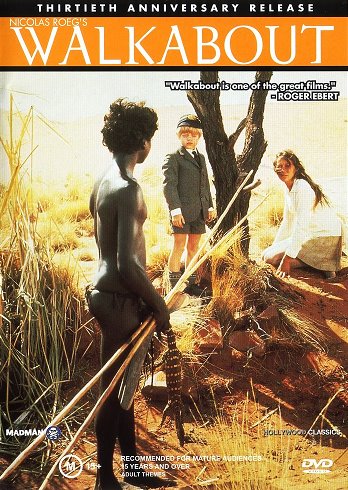
Walkabout is a 1971 British-Australian survival film directed by Nicolas Roeg and starring Jenny Agutter, Luc Roeg, and David Gulpilil. Edward Bond wrote the screenplay, which is loosely based on the 1959 novel Walkabout by James Vance Marshall. Set in the Australian outback, it centres on two white schoolchildren who are left to fend for themselves in the Australian outback and who come across a teenage Aboriginal boy who helps them to survive.
One of the first films in the Australian New Wave cinema movement, it received positive reviews despite being a commercial failure. Alongside Wake in Fright, it was one of two Australian films entered in competition for the Grand Prix du Festival at the 1971 Cannes Film Festival.[3] It is also held to be one of Roeg's masterpieces, along with Performance (1970), Don't Look Now (1973), and The Man Who Fell to Earth (1976). In 2005, the British Film Institute included it in their list of the '50 films you should see by the age of 14'.
- 4Reception
Plot[edit]
In November,[4] a white, city-bred teenaged schoolgirl and her much younger brother become stranded in the wilderness after their father goes berserk. After driving them far into the Australian outback, ostensibly for a picnic, the father suddenly begins shooting at the children. They run behind rocks for cover, whereupon he sets the car on fire and shoots himself in the head. The girl conceals what has happened from her brother and, after grabbing some food and supplies, the pair head out into the desert.
By the middle of the next day, they are weak and the boy can barely walk. Discovering a small water hole with a fruiting tree, they spend the day playing, bathing, and resting. By the next morning, the water has dried up. They are then discovered by an Aboriginal boy. Although the girl cannot communicate with him, due to the language barrier, her brother mimes their need for water and the newcomer cheerfully shows them how to draw it from the drying bed of the oasis. The three travel together, with the Aboriginal boy sharing food he has caught hunting. The boys learn to communicate slightly using words and sign language.
While in the vicinity of a plantation, a white woman walks past the Aboriginal boy, who simply ignores her when she speaks to him. She appears to see the other children, but they do not see her, and they continue on their journey. The children also discover a weather balloon belonging to a nearby research team working in the desert. After drawing markings of a modern-style house, the Aboriginal boy eventually leads them to an abandoned farm, and takes the other boy to a nearby road. The Aboriginal boy hunts down a water buffalo and is wrestling it to the ground when two white hunters appear in a truck and nearly run him over. He watches in shock as they shoot several buffalo with a rifle. The boy then returns to the farm, but passes by without speaking.
Later, the Aboriginal boy lies in a trance among a slew of buffalo bones, having painted himself in ceremonial markings. He returns to the farmhouse catching the undressing girl by surprise, and initiates a mating ritual by performing a courtship dance in front of her.[5] Although he dances outside all day and into the night until he becomes exhausted, she is frightened and hides from him, and tells her brother they will leave him the next day. In the morning, after they dress in their school uniforms, the brother takes her to the Aboriginal boy's body, hanging in a tree. Before leaving, the girl wipes ants from the dead boy's chest. Hiking up the road, the siblings find a nearly deserted mining town where a surly employee directs them towards nearby accommodation.
Much later, a businessman arrives home as the now grown-up girl prepares dinner; while he embraces her and relates office gossip, she imagines a scene in which she, her brother, and the Aboriginal boy are playing and swimming naked in a deep pool in the outback.
Cast[edit]
- Jenny Agutter as Girl
- Luc Roeg (credited as Lucien John) as White Boy
- David Gulpilil (miscredited as David Gumpilil) as Black Boy
- John Meillon as Father
- Robert McDarra as Man
- Pete Carver as No Hoper
- John Illingsworth as Husband
- Hilary Bamberger as Woman
- Barry Donnelly as Australian Scientist
- Noeline Brown as German Scientist
- Carlo Manchini as Italian Scientist
Production[edit]
The film was the second feature directed by Nicolas Roeg, a British filmmaker. He had long planned to make a film of the novel Walkabout, in which the children are Americans stranded by a plane crash. After the indigenous boy finds and leads them to safety, he dies of influenza contracted from them, as he has not been immunised. Roeg had not been able to find a script he was happy with, until the English playwright Edward Bond did a minimal 14-page screenplay. Roeg then obtained backing from two American businessmen, Max Raab and Si Litvinoff, who incorporated a company in Australia but raised the budget entirely in the US and sold world rights to 20th Century Fox.
Filming began in Sydney in August 1969 and later moved to Alice Springs,[2] and Roeg's son, Luc, played the younger boy in the film. Roeg brought an outsider's eye and interpretation to the Australian setting, and improvised greatly during filming. He commented, 'We didn’t really plan anything—we just came across things by chance…filming whatever we found.'[6] The film is an example of Roeg's well-defined directorial style, characterised by strong visual composition from his experience as a cinematographer, combined with extensive cross-cutting and the juxtaposition of events, location, or environments to build his themes.[7] The music was composed and conducted by John Barry, and produced by Phil Ramone, and the poem read at the end of the film is Poem 40 from A.E. Housman's A Shropshire Lad.
Reception[edit]
Walkabout fared poorly at the box office in Australia. Critics debated whether it could be considered an Australian film, and whether it was an embrace of or a reaction to the country's cultural and natural context.[6] In the US, the film was originally rated R by the MPAA due to nudity, but was reduced to a GP-rating (PG) on appeal.
Critic Roger Ebert called it 'one of the great films'.[8][9] He writes that it contains little moral or emotional judgement of its characters, and ultimately is a portrait of isolation in proximity. At the time, he stated: 'Is it a parable about noble savages and the crushed spirits of city dwellers? That's what the film's surface suggests, but I think it's about something deeper and more elusive: the mystery of communication.'[9] Film critic Edward Guthmann also notes the strong use of exotic natural images, calling them a 'chorus of lizards'.[10] In Walkabout, an analysis of the film, author Louis Nowra wrote: 'I was stunned. The images of the Outback were of an almost hallucinogenic intensity. Instead of the desert and bush being infused with a dull monotony, everything seemed acute, shrill, and incandescent. The Outback was beautiful and haunting.'[11]
Walkabout features several scenes of animal hunting and killing, such as a kangaroo being speared and bludgeoned to death. The Cinematograph Films (Animals) Act 1937 makes it illegal in the United Kingdom to distribute or exhibit material where the production involved inflicting pain or terror on an animal. Since the animals did not appear to suffer or be in distress the film was deemed to not contravene the Act.
The film includes scenes of nudity featuring Jenny Agutter, who the British Board of Film Classification (BBFC) surmised was 17 years old at the time of filming. The scenes did not pose a problem when submitted to the BBFC in 1971 and later in 1998. The Protection of Children Act 1978 prohibited distribution and possession of indecent images of people under the age of 16 so the issue of potential indecency had not been considered on previous occasions. However, the Sexual Offences Act 2003 raised the age threshold to 18 which meant the BBFC was required to consider the scenes of nudity in the context of the new law when the film was re-submitted in 2011. The BBFC reviewed the scenes and considered them not to be indecent and passed the film uncut.[1]
Legacy[edit]
Commenting on the film's enduring appeal, Roeg described the film in 1998 as 'a simple story about life and being alive, not covered with sophistry but addressing the most basic human themes; birth, death, mutability.'[12]
More than 40 years after its release, on review aggregator Rotten Tomatoes, the film holds a score of 84% based on reviews from 32 critics, with an average rating of 8.2 out of 10.[13]
References[edit]
- ^ abc'Walkabout'. British Board of Film Classification. Retrieved 11 June 2014.
- ^ abAndrew Pike and Ross Cooper, Australian Film 1900–1977: A Guide to Feature Film Production, Melbourne: Oxford University Press, 1998 p258
- ^'Official Selection 1971'. Festival de Cannes. France. Archived from the original on 2 December 2010.
Official Selection 1971..WALKABOUT directed by Nicolas ROEG
- ^It is announced on the radio that it is Remembrance Day
- ^Nicolas Roeg (1998). Walkabout (DVD commentary) (1998 ed.). United States: The Criterion Collection. Event occurs at 1 hour 20 minutes. ISBN0780020847.
- ^ abFiona Harma (2001). 'Walkabout'. The Oz Film Database. Murdoch University. Retrieved 18 February 2008.
- ^Chuck Kleinhans. 'Nicholas Roeg—Permutations without profundity'. Jump Cut: A Review of Contemporary Media. Retrieved 17 February 2008.
- ^Ebert, Roger (13 April 1997). 'Walkabout (1971)'. RogerEbert.com. Retrieved 18 November 2018.
- ^ abEbert, Roger. 'Walkabout by Nicolas Roeg'. The Criterion Collection. Retrieved 17 February 2008.
- ^Edward Guthmann (3 January 1997). 'Intriguing 'Walkabout' in the Past'. SFGate.com. San Francisco chronicle. Retrieved 18 February 2008.
- ^Louis Nowra (2003), Walkabout, NSW: Currency Press
- ^Danielsen, Shane (27 March 1998), Walkabout: An Outsider’s Vision Endures, The Australian (newspaper)
- ^'Walkabout'. Rotten Tomatoes. Retrieved 31 January 2013.
External links[edit]
- Walkabout on IMDb
- Walkabout at AllMovie
- Walkabout at Rotten Tomatoes
- Walkabout: Landscapes of Memory an essay by Paul Ryan at the Criterion Collection
- Walkabout at Oz Movies